Resources for teens

Ten Ideas for Youth to Educate their Community about Cyberbullying
By Sameer Hinduja and Justin W. Patchin

Outlines specific activities that adolescents can do to promote awareness about online bullying and teach others how to deal with it.

Hinduja, S. & Patchin, J. (2010). Ten Ideas for Youth to Educate their Community about Cyberbullying. Cyberbullying Research Center. Retrieved [insert date], from http://www.cyberbullying.us/teens_cyberbullying_prevention_activities_tips.pdf

Cyberbullying Word Find:
Talking to Youth about Internet Harassment

By Sameer Hinduja and Justin W. Patchin

A word search to be distributed to youth to promote discussion about cyberbullying and Internet safety.

Hinduja, S. & Patchin, J. (2009). Cyberbullying word find:
Talking to youth about Internet harassment. Cyberbullying Research Center. Retrieved [insert date], from http://www.cyberbullying.us/cyberbullying_word_find.pdf

Cyberbullying Crossword Puzzle:
Talking to Youth about Internet Harassment

By Sameer Hinduja and Justin W. Patchin

A crossword puzzle to be distributed to youth to promote discussion about cyberbullying.

Hinduja, S. & Patchin, J. (2009). Cyberbullying crossword puzzle:
Talking to youth about Internet harassment. Cyberbullying Research Center. Retrieved [insert date], from http://www.cyberbullying.us/cyberbullying_crossword.pdf

Cyberbullying Word Scramble:
Talking to Youth about Internet Harassment

By Sameer Hinduja and Justin W. Patchin

Unscramble the words to uncover cyberbullying-related concepts and web sites!

Hinduja, S. & Patchin, J. (2009). Cyberbullying word scramble:
Talking to youth about Internet harassment. Cyberbullying Research Center. Retrieved [insert date], from http://www.cyberbullying.us/Cyberbullying_word_scramble.pdf

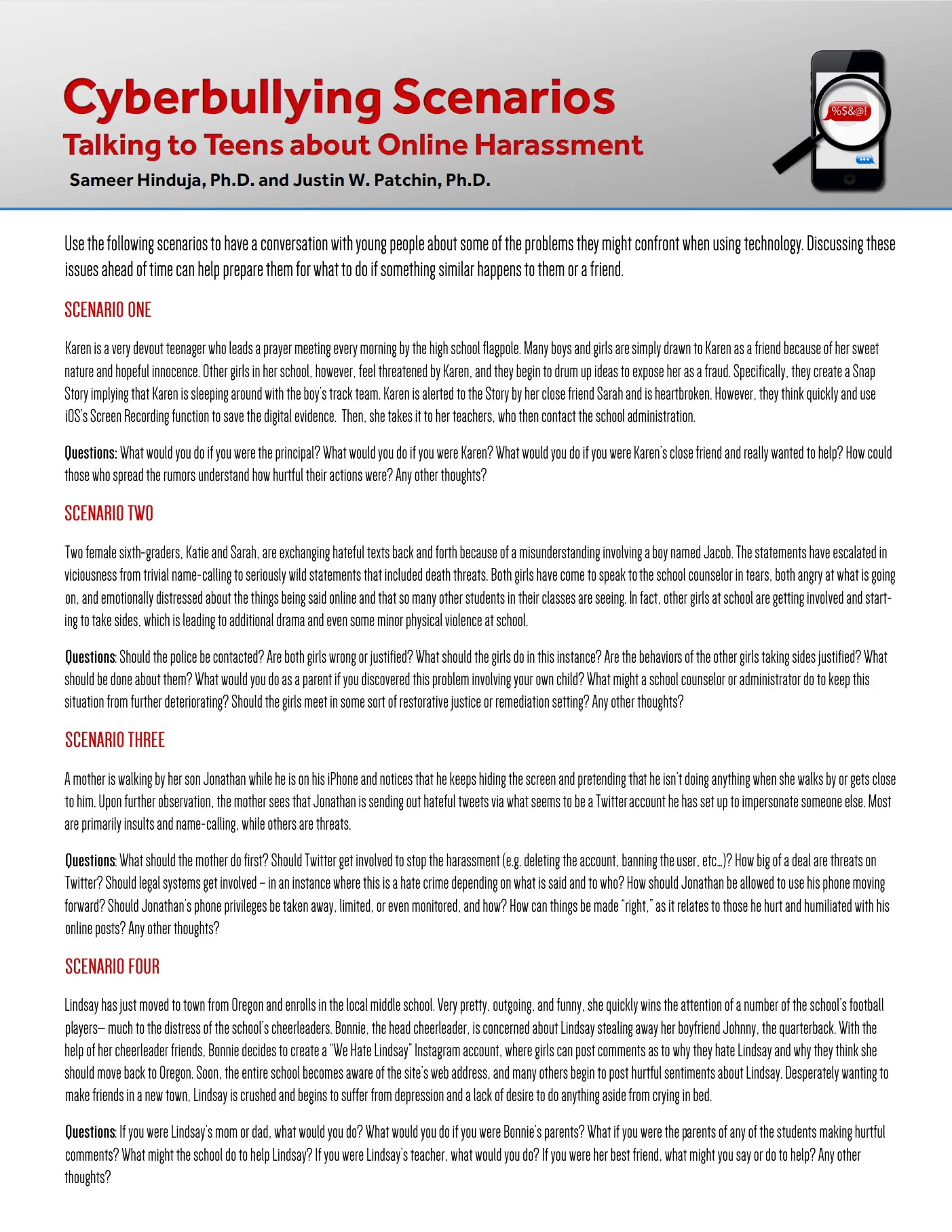
Cyberbullying Scenarios:
Talking to Youth about Internet Harassment
By Sameer Hinduja and Justin W. Patchin

Engage parents, educators, or youth in a discussion about cyberbullying by reading and discussing these scenarios.

Hinduja, S. & Patchin, J. (2009). Cyberbullying word scramble:
Talking to youth about Internet harassment. Cyberbullying Research Center. Retrieved [insert date], from http://www.cyberbullying.us/Cyberbullying_Scenarios.pdf

Quiz: The Facts about Cyberbullying
By Sameer Hinduja and Justin W. Patchin

This quiz tests your knowledge about what the research says about cyberbullying.

Hinduja, S. & Patchin, J. (2009). Quiz:
The Facts about Cyberbullying. Cyberbullying Research Center. Retrieved [insert date], from http://www.cyberbullying.us/quiz.php?QUIZNUM=1

Quiz: Dealing with Cyberbullying
By Sameer Hinduja and Justin W. Patchin

This quiz was created for children and teenagers to determine how equipped they are to deal with online harassment.

Hinduja, S. & Patchin, J. (2009). Quiz:
Dealing with Cyberbullying. Cyberbullying Research Center. Retrieved [insert date], from http://www.cyberbullying.us/quiz.php?QUIZNUM=2

Quiz: Addressing Cyberbullying
By Sameer Hinduja and Justin W. Patchin

This quiz was created for children and teenagers to determine how equipped they are to deal with online harassment.

Hinduja, S. & Patchin, J. (2009). Quiz:
Addressing Cyberbullying. Cyberbullying Research Center. Retrieved [insert date], from http://www.cyberbullying.us/quiz.php?QUIZNUM=3

A Student’s Guide to Personal Publishing
By Justin W. Patchin and Sameer Hinduja

This handout discusses issues that students should consider when creating offline or online content and then publishing it for others to see. It also provides guidelines that can inform how best to make and share ideas, opinions, and multi-media in a way that does not lead to negative repercussions.

Hinduja, S. & Patchin, J. (2010). A Student’s Guide to Personal Publishing. Cyberbullying Research Center. Retrieved [insert date], from http://www.cyberbullying.us/Students_Guide_to_Personal_Publishing.pdf

Safe and Responsible Social Networking:
Strategies for Keeping Yourself Safe Online

By Sameer Hinduja and Justin W. Patchin

This handout provides commonsense strategies for encouraging and enabling youth to think about important issues when posting content on social networking sites.

Hinduja, S. & Patchin, J. (2009). Safe and Responsible Social Networking: Strategies for Keeping Yourself Safe Online. Cyberbullying Research Center. Retrieved [insert date], from http://www.cyberbullying.us/safe_responsible_social_networking.pdf

Password Safety:
Top Ten Tips for Teens

By Sameer Hinduja and Justin W. Patchin

This Top Ten List educates youth on how best to create and use passwords for online accounts in order to keep them from being victimized.

Hinduja, S. & Patchin, J. (2009). Password safety: Top ten tips for teens. Cyberbullying Research Center. Retrieved [insert date], from http://www.cyberbullying.us/Top_Ten_Teen_Tips_Passwords.pdf

Cell Phone Safety:
Top Ten Tips for Teens

By Sameer Hinduja and Justin W. Patchin

This Top Ten List specifies what teenagers need to keep in mind as they use cell phones at home, at school, and in vehicles.

Hinduja, S. & Patchin, J. (2009). Cell phone safety: Top ten tips for teens. Cyberbullying Research Center. Retrieved [insert date], from http://www.cyberbullying.us/Top_Ten_Teen_Tips_Cell_Phones.pdf

Preventing Cyberbullying:
Top Ten Tips for Teens

By Sameer Hinduja and Justin W. Patchin

This Top Ten List specifies how teenagers can keep themselves safe from online harassment and victimization online.

Hinduja, S. & Patchin, J. (2012). Preventing Cyberbullying: Top ten tips for teens. Cyberbullying Research Center. Retrieved [insert date], from http://www.cyberbullying.us/Top_Ten_Tips_Teens_Prevention.pdf

Responding to Cyberbullying:
Top Ten Tips for Teens

By Sameer Hinduja and Justin W. Patchin

This Top Ten List specifies how teenagers can deal with online harassment and victimization when it happens to them.

Hinduja, S. & Patchin, J. (2012). Responding to Cyberbullying: Top ten tips for teens. Cyberbullying Research Center. Retrieved [insert date], from http://www.cyberbullying.us/Top_Ten_Tips_Teens_Response.pdf


Resources for educators

Cyberbullying Fact Sheet

web page format

download PDF

Cyberbullying Fact Sheet:
Identification, Prevention, and Response

By Sameer Hinduja and Justin W. Patchin

This document is a five-page summary – filled with as much useful information as possible – to equip educators and parents to spot cyberbullying, respond to it appropriately and meaningfully, and to prevent its future occurrence among the children and teenagers they care for. If you only have time to read one fact sheet from the Cyberbullying Research Center to get up-to-speed about the problem and what you can do, read this one.

Hinduja, S. & Patchin, J. (2010). Cyberbullying fact sheet:
Identification, Prevention, and Response. Cyberbullying Research Center. Retrieved [insert date], from http://www.cyberbullying.us/Cyberbullying_Identification_Prevention_Response_Fact_Sheet.pdf

Cyberbullying Legal Issues

web page format

download PDF

Cyberbullying Fact Sheet:
A Brief Review of Relevant Legal and Policy Issues

By Sameer Hinduja and Justin W. Patchin

This Fact Sheet provides a summary of important court cases and pending legislation that can help school districts evaluate and improve their current cyberbullying policies.

Hinduja, S. & Patchin, J. (2009). Cyberbullying fact sheet:
A Brief Review of Relevant Legal and Policy Issues. Cyberbullying Research Center. Retrieved [insert date], from http://www.cyberbullying.us/cyberbullying_legal_issues.pdf

How to Deal with Sexting Among Teenagers

web page format

download PDF

Sexting:
A Brief Guide for Educators and Parents

By Sameer Hinduja and Justin W. Patchin

This Fact Sheet defines “sexting” as it occurs among adolescents, and summarizes the current state of research on the problem. It also details informal and formal responses – particularly from legal and political authorities – and describes what schools should do as it relates to policy and response efforts. Finally, it suggests some practical prevention strategies that educators can implement to reduce its occurrence and perceived acceptability among students.

Hinduja, S. & Patchin, J. (2010). Sexting: A Brief Guide for Educators and Parents. Cyberbullying Research Center. Retrieved [insert date], from http://www.cyberbullying.us/Sexting_Fact_Sheet.pdf

Cyberbullying Incident Tracking Form

download now

Cyberbullying Incident Tracking Form
By Sameer Hinduja and Justin W. Patchin

Use this document to track individual incidents of cyberbullying that occur at your school.

Hinduja, S. & Patchin, J. (2009). Cyberbullying incident tracking form. Cyberbullying Research Center. Retrieved [insert date], from http://www.cyberbullying.us/cyberbullying_incident_tracking_form.pdf

Cyberbullying Trustee Poster
By Sameer Hinduja and Justin W. Patchin

Post this prominently on your office or classroom door to let your students know that they can trust you. You will listen to their concerns about cyberbullying and take them seriously. You will do something about the problem and get it resolved.

Hinduja, S. & Patchin, J. (2009). Cyberbullying trustee poster. Cyberbullying Research Center. Retrieved [insert date], from http://www.cyberbullying.us/Cyberbullying_Trustee.pdf

Cyberbullying Report Card:
Assessing School-level Awareness and Understanding

By Sameer Hinduja and Justin W. Patchin

Complete this Cyberbullying Report Card to determine how well your school is currently dealing with cyberbullying issues. Identify weaknesses in curriculum and policy and determine an appropriate course of action to remedy any deficiencies.

Hinduja, S. & Patchin, J. (2009). Cyberbullying report card:
Assessing school-level awareness and understanding. Cyberbullying Research Center. Retrieved [insert date], from http://www.cyberbullying.us/Cyberbullying_Report_Card.pdf

Cyberbullying and Schools:
Edweek Live Chat

By Sameer Hinduja and Justin W. Patchin

At its best, the Internet helps students find information and stay in touch with friends through everything from text-messages and blogs to social-networking and other video- and photo-sharing Web sites. But the Internet can also enable students to aggressively target and harm their peers. This chat will inform educators and parents on how to recognize cyberbullying and protect young people from becoming victims. Click the link at left to review the archive of the discussion related to cyberbullying, a problem affecting growing numbers of students, administrators, teachers, and parents.

Cyberbullying Scenarios:
Talking to Youth about Internet Harassment
By Sameer Hinduja and Justin W. Patchin

Engage parents, educators, or youth in a discussion about cyberbullying by reading and discussing these scenarios.

Hinduja, S. & Patchin, J. (2009). Cyberbullying word scramble:
Talking to youth about Internet harassment. Cyberbullying Research Center. Retrieved [insert date], from http://www.cyberbullying.us/Cyberbullying_Scenarios.pdf

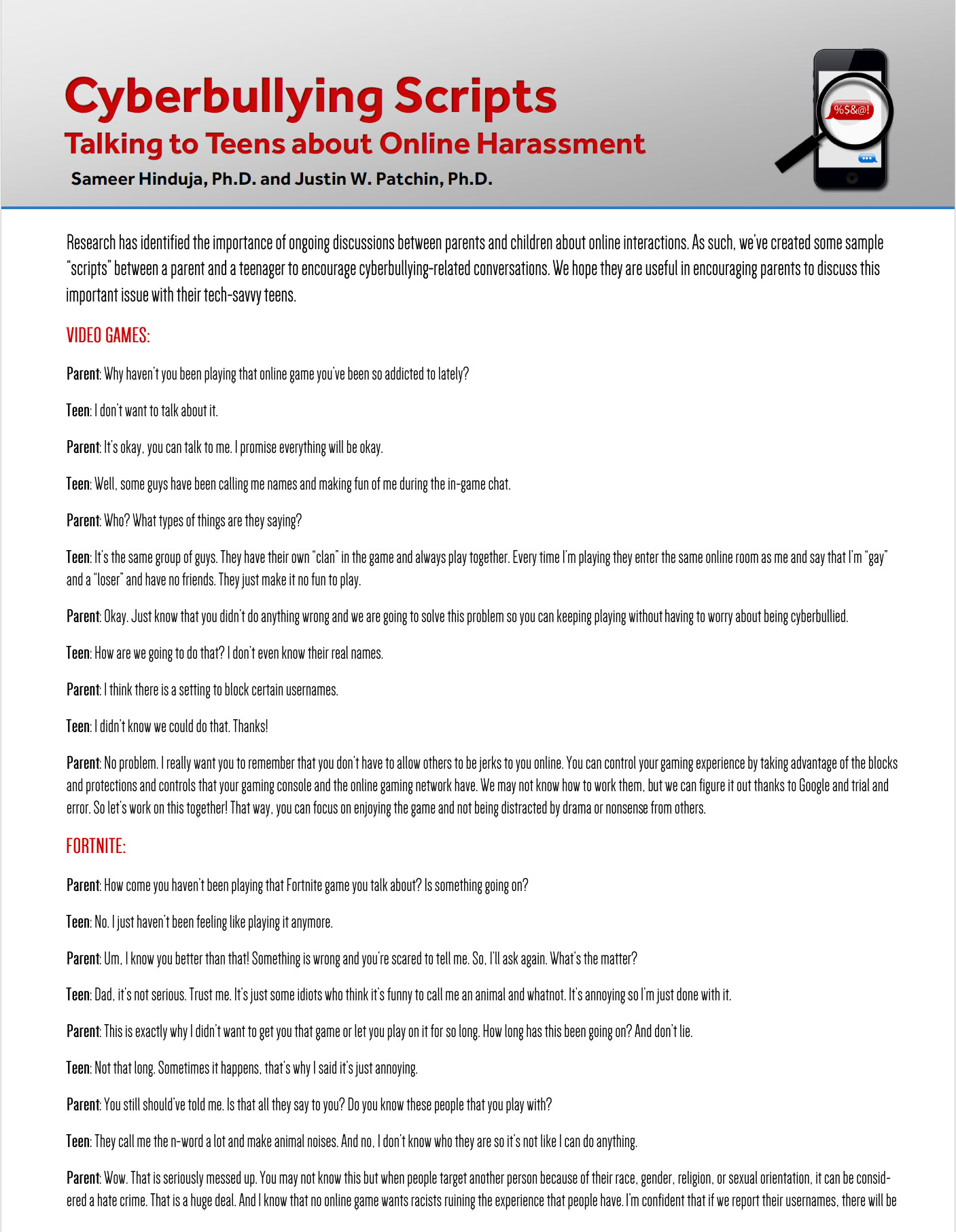
Cyberbullying Scripts for Parents to Promote Dialog and Discussion
By Sameer Hinduja and Justin W. Patchin

Provides parent/teenager “scripts” to promote dialogue and discussion about cyberbullying

Hinduja, S. & Patchin, J. (2009). Cyberbullying Scripts for Parents to Promote Dialog and Discussion. Cyberbullying Research Center. Retrieved [insert date], from http://www.cyberbullying.us/cyberbullying_scripts.pdf

A Student’s Guide to Personal Publishing
By Justin W. Patchin and Sameer Hinduja

This handout discusses issues that students should consider when creating offline or online content and then publishing it for others to see. It also provides guidelines that can inform how best to make and share ideas, opinions, and multi-media in a way that does not lead to negative repercussions.

Hinduja, S. & Patchin, J. (2010). A Student’s Guide to Personal Publishing. Cyberbullying Research Center. Retrieved [insert date], from http://www.cyberbullying.us/Students_Guide_to_Personal_Publishing.pdf

Safe and Responsible Social Networking:
Strategies for Keeping Yourself Safe Online

By Sameer Hinduja and Justin W. Patchin

This handout provides commonsense strategies for encouraging and enabling youth to think about important issues when posting content on social networking sites.

Hinduja, S. & Patchin, J. (2009). Safe and Responsible Social Networking: Strategies for Keeping Yourself Safe Online. Cyberbullying Research Center. Retrieved [insert date], from http://www.cyberbullying.us/safe_responsible_social_networking.pdf

Preventing Cyberbullying:
Top Ten Tips for Educators

By Sameer Hinduja and Justin W. Patchin

This Top Ten List provides specific guidance for those in the school system to reduce the vulnerability of students to online harassment.

Responding to Cyberbullying:
Top Ten Tips for Educators

By Sameer Hinduja and Justin W. Patchin

This Top Ten List informs school professionals about how best to deal with cyberbullying cases when they occur among students.

Hinduja, S. & Patchin, J. (2009). Responding to cyberbullying: Top ten tips for educators. Cyberbullying Research Center. Retrieved [insert date], from http://www.cyberbullying.us/
Top_Ten_Tips_Educators_Cyberbullying_Response.pdf


Resources for parents

Cyberbullying Fact Sheet

web page format

download PDF

Cyberbullying Fact Sheet:
Identification, Prevention, and Response

By Sameer Hinduja and Justin W. Patchin

This document is a five-page summary – filled with as much useful information as possible – to equip educators and parents to spot cyberbullying, respond to it appropriately and meaningfully, and to prevent its future occurrence among the children and teenagers they care for. If you only have time to read one fact sheet from the Cyberbullying Research Center to get up-to-speed about the problem and what you can do, read this one.

Hinduja, S. & Patchin, J. (2010). Cyberbullying fact sheet:
Identification, Prevention, and Response. Cyberbullying Research Center. Retrieved [insert date], from http://www.cyberbullying.us/Cyberbullying_Identification_Prevention_Response_Fact_Sheet.pdf

How to Deal with Sexting Among Teenagers

web page format

download PDF

Sexting:
A Brief Guide for Educators and Parents

By Sameer Hinduja and Justin W. Patchin

This Fact Sheet defines “sexting” as it occurs among adolescents, and summarizes the current state of research on the problem. It also details informal and formal responses – particularly from legal and political authorities – and describes what schools should do as it relates to policy and response efforts. Finally, it suggests some practical prevention strategies that educators can implement to reduce its occurrence and perceived acceptability among students.

Hinduja, S. & Patchin, J. (2010). Sexting: A Brief Guide for Educators and Parents. Cyberbullying Research Center. Retrieved [insert date], from http://www.cyberbullying.us/Sexting_Fact_Sheet.pdf

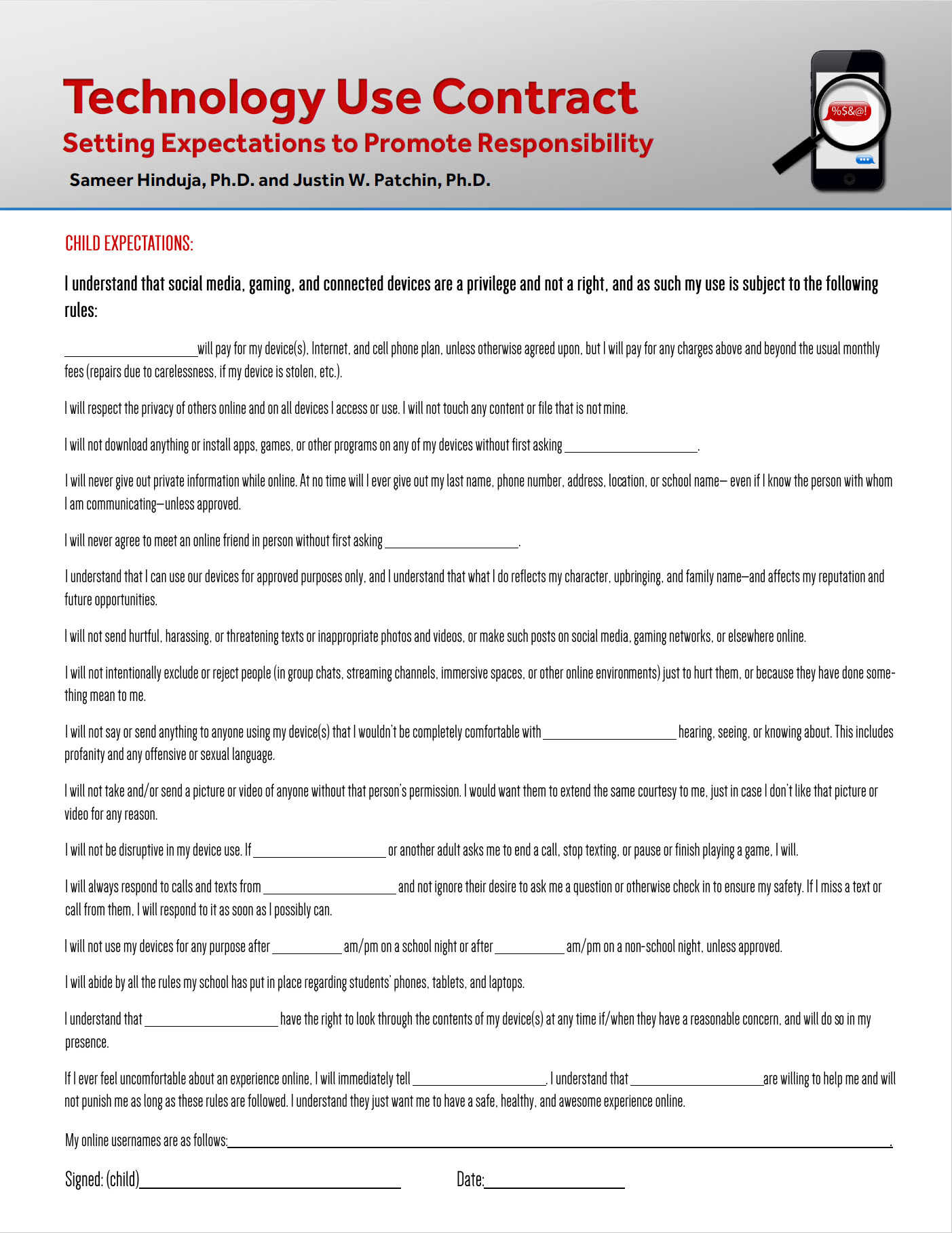
Family Internet Use Contract

download now

Family Internet Use Contract
By Sameer Hinduja and Justin W. Patchin

This is a formal agreement to be signed by both parents and children to help facilitate an open line of communication regarding the appropriate use of the Internet. Feel free to customize for your own needs.

Hinduja, S. & Patchin, J. (2009). Family Internet use contract. Cyberbullying Research Center. Retrieved [insert date], from http://www.cyberbullying.us/cyberbullying_internet_use_contract.pdf

Cell Phone Use Contract
By Sameer Hinduja and Justin W. Patchin

This is a formal agreement to be signed by both parents and children to help facilitate an open line of communication regarding the appropriate use of cell phones.

Hinduja, S. & Patchin, J. (2009). Cell phone use contract. Cyberbullying Research Center. Retrieved [insert date], from http://www.cyberbullying.us/cyberbullying_cell_phone_contract.pdf

Ten Ideas for Youth to Educate their Community about Cyberbullying
By Sameer Hinduja and Justin W. Patchin

Outlines specific activities that adolescents can do to promote awareness about online bullying and teach others how to deal with it.

Hinduja, S. & Patchin, J. (2010). Ten Ideas for Youth to Educate their Community about Cyberbullying. Cyberbullying Research Center. Retrieved [insert date], from http://www.cyberbullying.us/teens_cyberbullying_prevention_activities_tips.pdf

Cyberbullying Scripts for Parents to Promote Dialog and Discussion
By Sameer Hinduja and Justin W. Patchin

Provides parent/teenager “scripts” to promote dialogue and discussion about cyberbullying

Hinduja, S. & Patchin, J. (2009). Cyberbullying Scripts for Parents to Promote Dialog and Discussion. Cyberbullying Research Center. Retrieved [insert date], from http://www.cyberbullying.us/cyberbullying_scripts.pdf

Cyberbullying Scenarios:
Talking to Youth about Internet Harassment
By Sameer Hinduja and Justin W. Patchin

Engage parents, educators, or youth in a discussion about cyberbullying by reading and discussing these scenarios.

Hinduja, S. & Patchin, J. (2009). Cyberbullying word scramble:
Talking to youth about Internet harassment. Cyberbullying Research Center. Retrieved [insert date], from http://www.cyberbullying.us/Cyberbullying_Scenarios.pdf

Quiz: The Facts about Cyberbullying
By Sameer Hinduja and Justin W. Patchin

This quiz tests your knowledge about what the research says about cyberbullying.

Hinduja, S. & Patchin, J. (2009). Quiz:
The Facts about Cyberbullying. Cyberbullying Research Center. Retrieved [insert date], from http://www.cyberbullying.us/quiz.php?QUIZNUM=1

Quiz: Dealing with Cyberbullying
By Sameer Hinduja and Justin W. Patchin

This quiz was created for children and teenagers to determine how equipped they are to deal with online harassment.

Hinduja, S. & Patchin, J. (2009). Quiz:
Dealing with Cyberbullying. Cyberbullying Research Center. Retrieved [insert date], from http://www.cyberbullying.us/quiz.php?QUIZNUM=2

Quiz: Addressing Cyberbullying
By Sameer Hinduja and Justin W. Patchin

This quiz was created for children and teenagers to determine how equipped they are to deal with online harassment.

Hinduja, S. & Patchin, J. (2009). Quiz:
Addressing Cyberbullying. Cyberbullying Research Center. Retrieved [insert date], from http://www.cyberbullying.us/quiz.php?QUIZNUM=3

A Student’s Guide to Personal Publishing
By Justin W. Patchin and Sameer Hinduja

This handout discusses issues that students should consider when creating offline or online content and then publishing it for others to see. It also provides guidelines that can inform how best to make and share ideas, opinions, and multi-media in a way that does not lead to negative repercussions.

Hinduja, S. & Patchin, J. (2010). A Student’s Guide to Personal Publishing. Cyberbullying Research Center. Retrieved [insert date], from http://www.cyberbullying.us/Students_Guide_to_Personal_Publishing.pdf

Safe and Responsible Social Networking:
Strategies for Keeping Yourself Safe Online

By Sameer Hinduja and Justin W. Patchin

This handout provides commonsense strategies for encouraging and enabling youth to think about important issues when posting content on social networking sites.

Hinduja, S. & Patchin, J. (2009). Safe and Responsible Social Networking: Strategies for Keeping Yourself Safe Online. Cyberbullying Research Center. Retrieved [insert date], from http://www.cyberbullying.us/safe_responsible_social_networking.pdf

Preventing Cyberbullying:
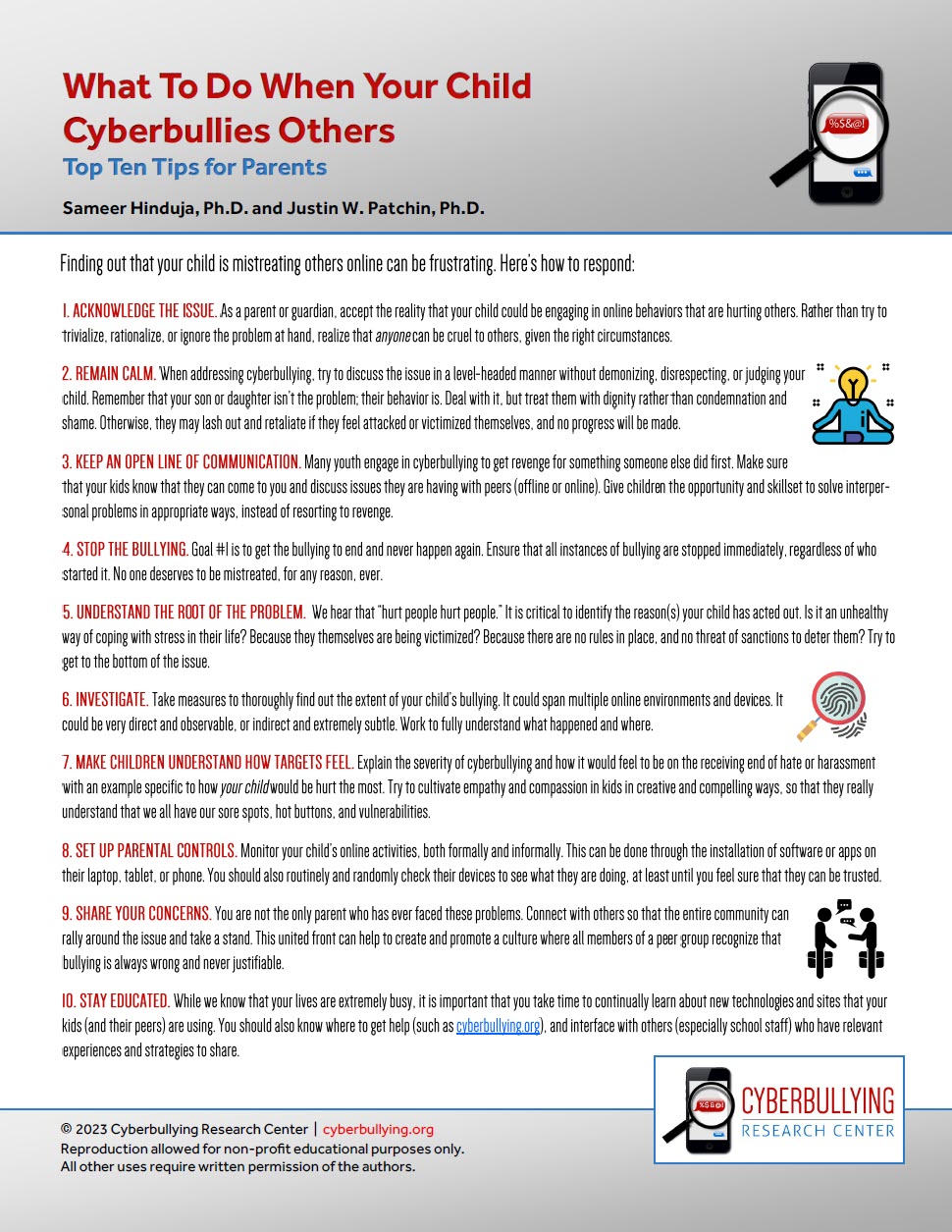
Top Ten Tips for Parents

By Sameer Hinduja and Justin W. Patchin
This Top Ten List outlines strategies that parents can implement at home to keep their kids safe from cyberbullying victimization.

Responding to Cyberbullying:
Top Ten Tips for Parents

By Sameer Hinduja and Justin W. Patchin

This Top Ten List outlines strategies that parents can implement at home to keep their kids safe from cyberbullying victimization


Reference Materials

Cyberbullying Fact Sheet:
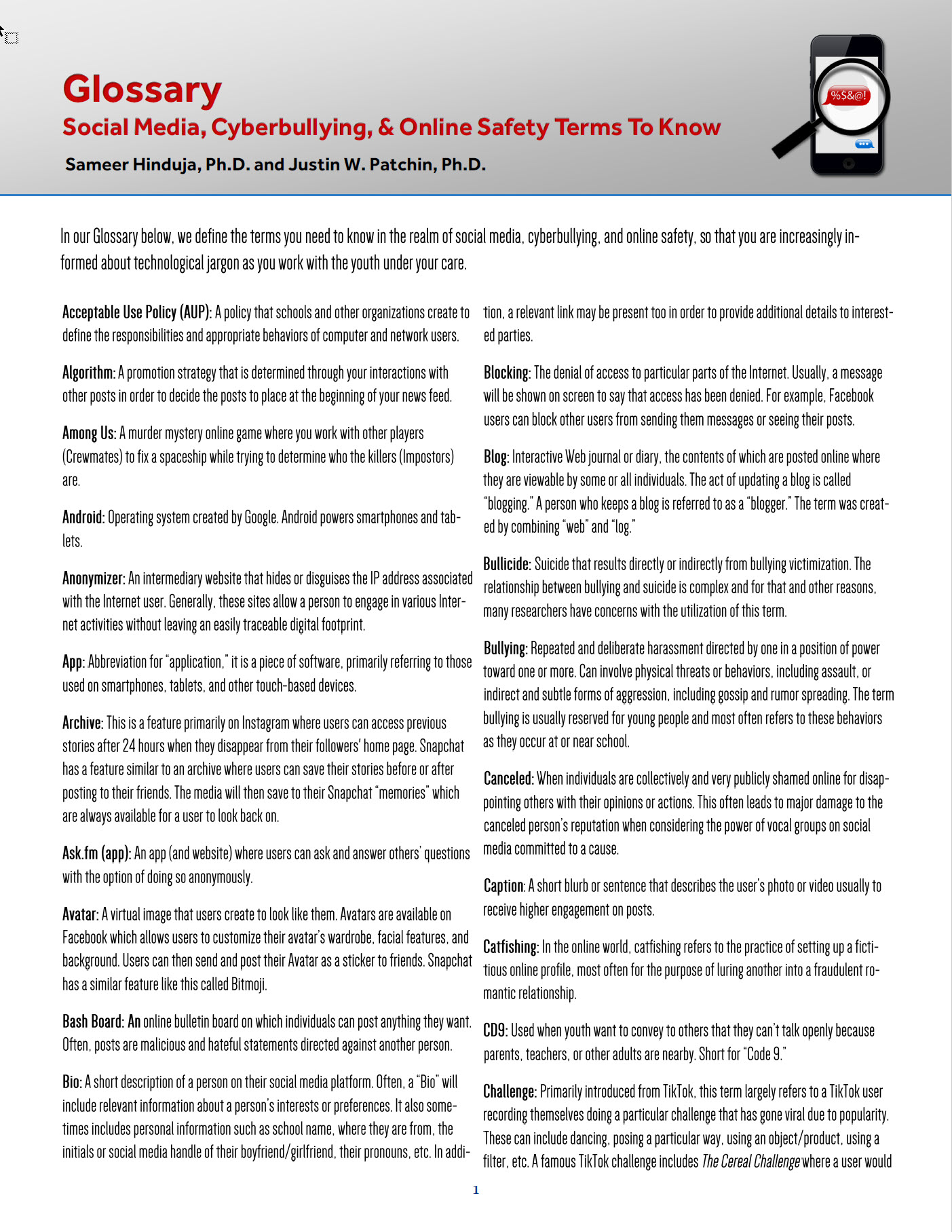
Common Chat Room and Text Messaging Abbreviations

By Sameer Hinduja and Justin W. Patchin

This Fact Sheet defines and explains the multiple acronyms and shortcuts used by teens during computer-mediated communication such as texting, instant messaging, and chatting.

Hinduja, S. & Patchin, J. (2009). Cyberbullying Fact Sheet:
Common Chat Room and Text Messaging Abbreviations. Cyberbullying Research Center. Retrieved [insert date], from http://www.cyberbullying.us/cyberbullying_chat_abbreviations.pdf

Cyberbullying Fact Sheet:
How to Preserve Cyberbullying Evidence Through Screenshots

By Sameer Hinduja and Justin W. Patchin

This Fact Sheet provides instructions on how to create an image of the contents of your computer desktop so that evidence of Internet harassment can be saved and used to support a case.

Hinduja, S. & Patchin, J. (2009). Cyberbullying fact sheet: How to preserve cyberbullying evidence through screenshots. Cyberbullying Research Center. Retrieved [insert date], from http://www.cyberbullying.us/making_cyberbullying_screenshots.pdf

Cyberbullying Fact Sheet:
Viewing Email Header Information

By Sameer Hinduja and Justin W. Patchin

This Fact Sheet specifies how individuals who receive malicious emails can view the email header information to discern the Internet Service Provider to contact and alert of the situation.

Hinduja, S. & Patchin, J. (2009). Cyberbullying fact sheet: Viewing email header information. Cyberbullying Research Center. Retrieved [insert date], from http://www.cyberbullying.us/viewing_cyberbullying_email_headers.pdf

Network Query Toolclick here

Network Query Tool
By Sameer Hinduja and Justin W. Patchin

Use this network query tool to identify the Internet Service Provider associated with the Internet Protocol (IP) address of a cyberbully.